Context
Stadium Live is a second-screen app for sports fans, built around predictions on the moments that make a game worth watching. Not just “how many points will LeBron score tonight,” but “will the broadcast pan to Kevin Durant’s bald spot.” The premise: enjoying sports isn’t linear, so engaging with it shouldn’t be either.
By 2025 the core staking loop was solid and users loved competing in solo challenges. But it was solitary, with no way to play directly with friends, a glaring gap for a community-first product. I was asked to design a feature, tied to that core loop, that was at once retentive, viral, and revenue-generating.
Problem
Solo play wasn’t broken, but it had hit a ceiling. In consumer products, and games especially, bringing something fresh isn’t a nice-to-have; it’s the cost of staying relevant. The clearest signal was in the data: even our most retentive users, the ones who opened the app daily, weren’t referring anyone. That was strange, people usually can’t help talking about an app they use every day.
The reason, we concluded, was that there was no real reason to have a friend on Stadium Live. Staking was something you did alone; a friend’s presence didn’t change it. Our existing “join so I get X” referral push wasn’t bad, just stale, and it wasn’t driving the virality we needed. Staking with friends was the unlock, fusing the social pull of playing together with the loop people already came back for, and giving a friend a real role instead of a one-time incentive.
Approach
I aligned with the PM on what success meant first. All three goals mattered, but optimizing for everything at once is a good way to hit none, so we ranked them: virality and retention as priorities, monetization a welcome secondary. That order became the tie-breaker for every decision after.
Rather than jump to a solution, I ran a team brainstorming workshop to widen the field first, generating everything from small virality plays to ambitious multiplayer concepts. We plotted them on an effort-versus-impact chart and sifted down. Staking together kept rising to the top: high impact, tightly coupled to the core loop, and a natural fit for our priorities.
With the concept set, two principles guided the design:
- Simplicity. Make the next step obvious. I used progressive disclosure to keep the core focused while keeping deeper detail within reach, and built a guided tutorial with real screens and live inputs so first-timers learned by doing.
- Non-stale play. No two days should feel the same. Stakes already changed daily, and we layered in rotating game modes and time-limited team rewards to keep the loop fresh across a long season.
My biggest assumption was that players would intuitively grasp a brand-new multiplayer mode. They didn’t, at least not at first, so that became what I designed hardest against. External playtesting and internal dogfooding ran throughout: I watched real people get stuck, then tightened the flow until the next move was always obvious.
Collaboration
I worked with a PM, two engineers (head of engineering and a senior engineer), and a graphic designer who brought real delight to the experience. On a small team, staying coordinated mattered more than ceremony.
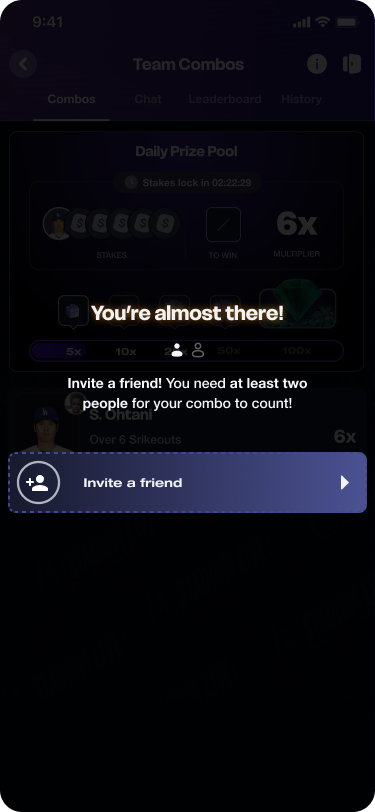
The first iteration tried to fit everything on the home screen. It worked on paper but fought the simplicity principle, so I reworked it into something more integrated: a fast-action entry point and contextual islands that surfaced the feature without crowding the core experience. To keep engineering unblocked, I prototyped fast and stayed a step ahead, so we rarely built the same thing twice.
Most disagreements came down to the bells and whistles. There was pressure to strip the delight to ship leaner, and I pushed to keep it, because a product like this is supposed to be fun. My analogy: it’s like playing pinball where the results just print to a text editor. Technically it works, but who would want to play it? The delight wasn’t decoration, it was the point.
Solution
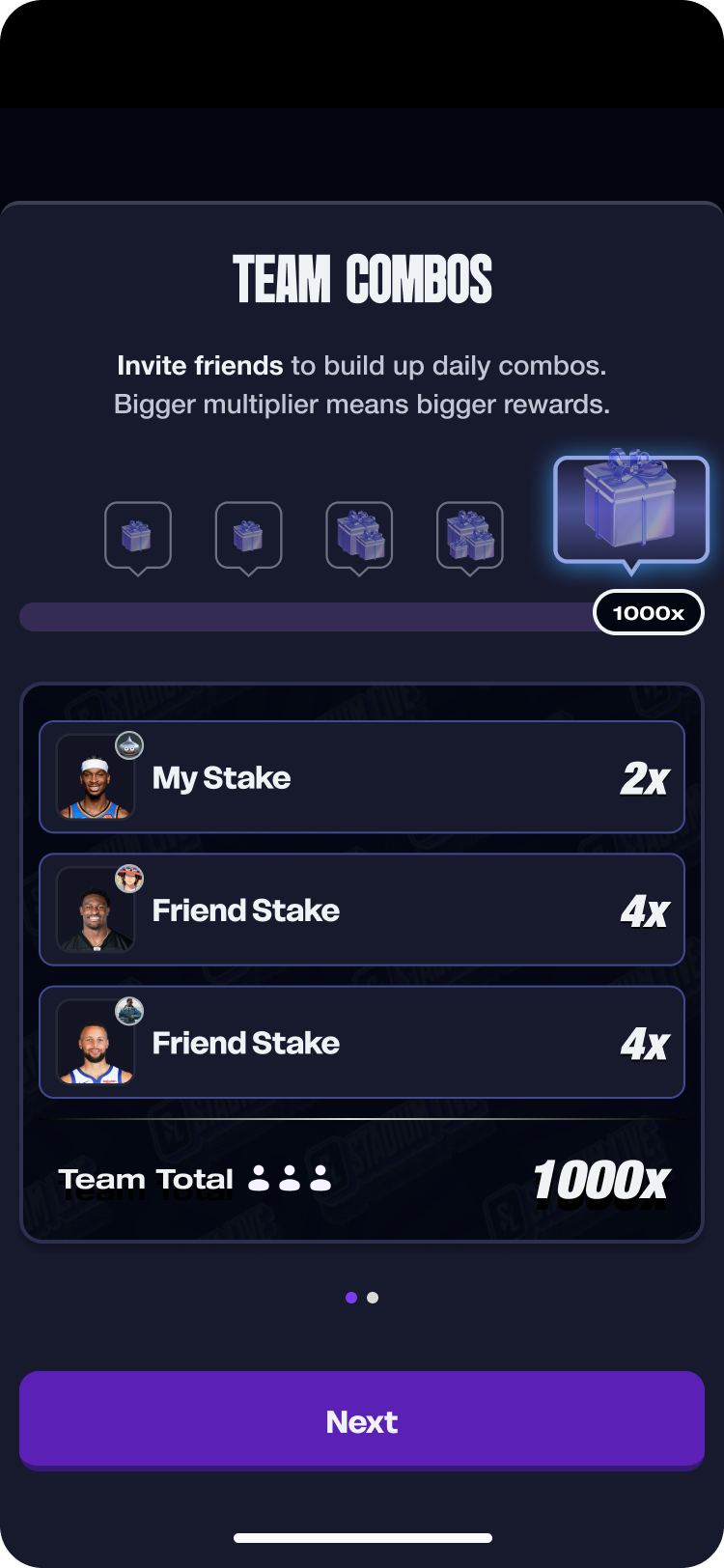
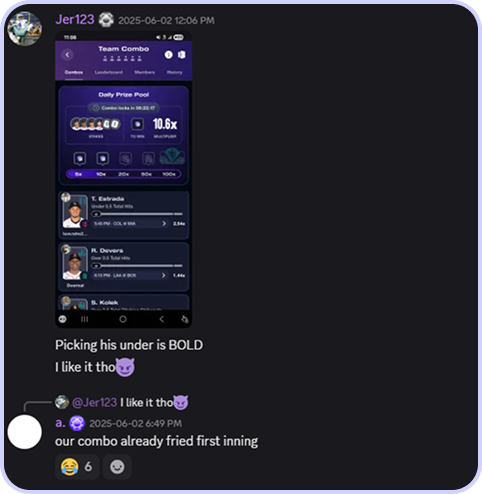
Team Combos turns a solo prediction into a shared one. The flow is built to get a group playing together fast:
- A user makes a stake, like “LeBron over 26.5 points tonight.”
- They invite friends, who join the group and add their own picks.
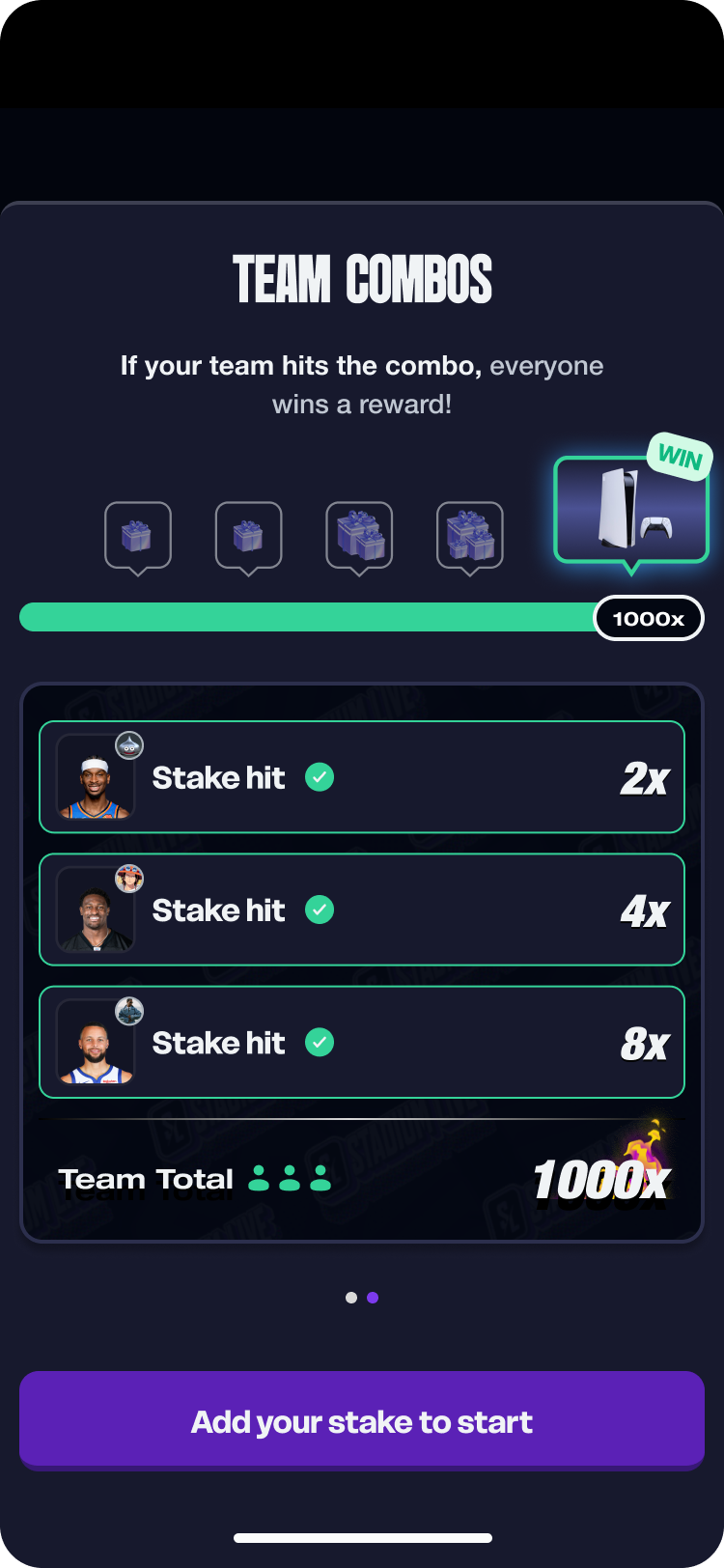
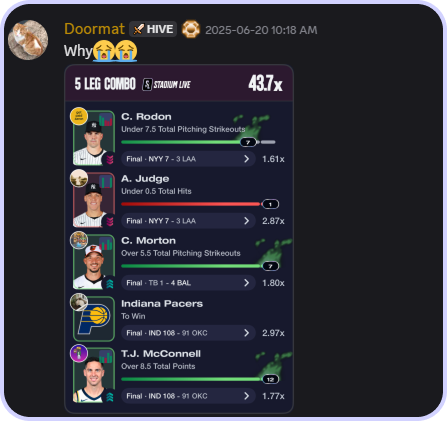
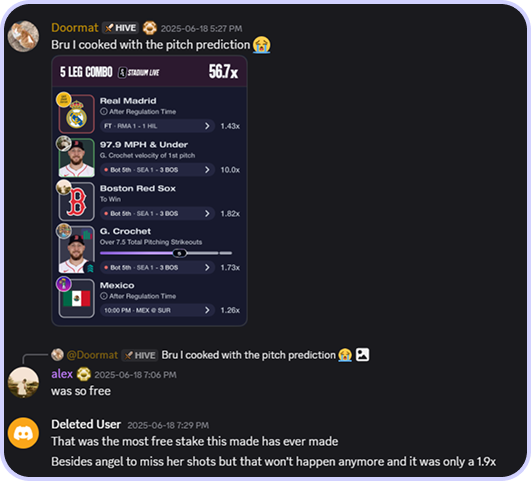
- Everyone’s predictions stack into a single parlay; the riskier the combo, the bigger the payout.
- The group tracks it live and wins or loses together.
Those stacked picks play for real stakes: coins, premium currency, and IRL prizes like PS5s and sneakers. And like any parlay, one wrong pick ends the run. That all-or-nothing tension is what makes it social, forcing planning, communication, and real trust in your team.
My proudest decision wasn’t visual, it was a piece of user logic. Stakes are anchored to when a game starts, but people join at all hours. Reconciling those two timelines so a friend joining at any point still got a fair, coherent game was the trickiest part of the feature. I landed on a model that held up across every join scenario.
When a combo hits, it’s genuinely magical. A whole group holds its breath on the final leg, and when it lands the winners get real prizes and a wave of social clout, with big wins broadcast across the app and the community Discord, feeding straight back into virality.
I launched with simple bets first: the thrill of playing together matters more than the sophistication of the wager, so the early experience stayed approachable. More complex bet types unlocked over time, once players understood the core game, adding depth without overwhelming anyone new.
Impact
Team Combos shipped for the new season and became the app’s first genuinely social surface. The numbers moved, and so did the way players talked about it.
“I like that users can quickly hop on, choose their stake, and they’re done. Not a big time commitment for something that can be very exciting.”
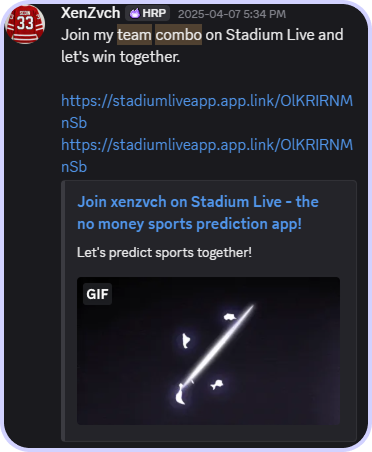
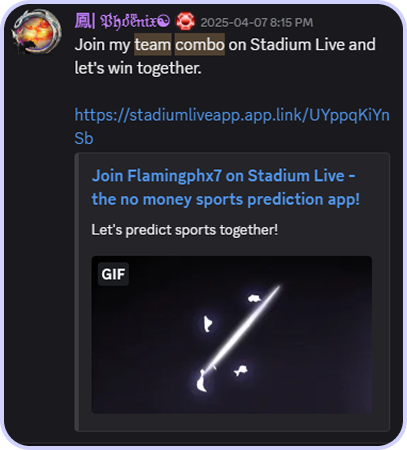
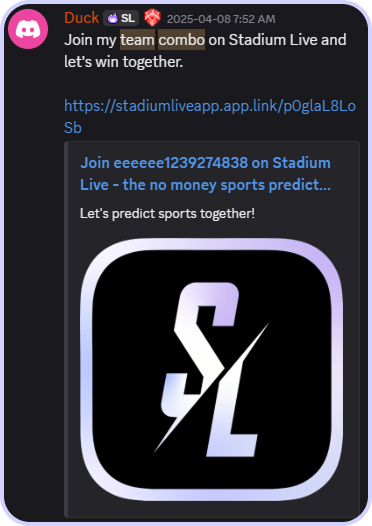
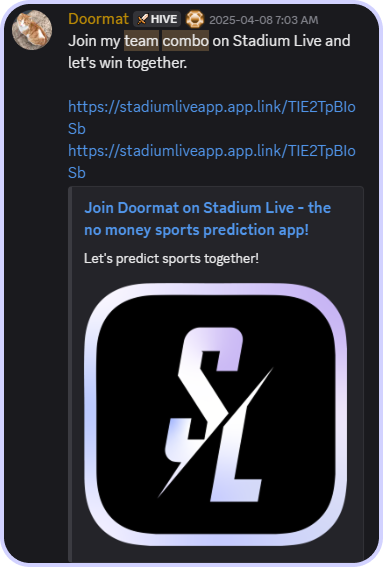
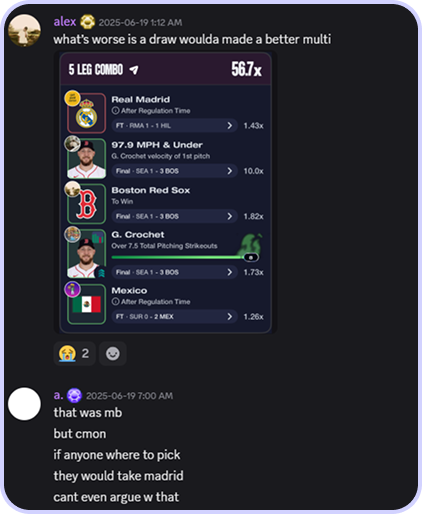
Two things I’d push further next time. First, easier ways to invite a friend: people shared, but we underestimated the effort of downloading a new app and creating an account just to join a combo, and that friction cost conversions at the door. Second, stronger reasons to upgrade to Elite, our premium tier: people were inviting friends but still not paying, so Team Combos should create real FOMO for free users to pull them toward converting.